
Against Being Right
What's better than never being wrong? Being loved.

I think we can all agree that there’s nothing more satisfying in life than being proven correct. We love to be right. It’s most delicious when you tell someone what’s right, they ignore you, and then later you get to say I told you so and peacock about it. It feels great to win an argument or to gossip with friends about how so-and-so is wrong and your group is right. It’s a bonding experience to talk about “that other oratory,” or “that novus parish” who do the music all wrong and don’t have the liturgical rubrics exactly correct. We love to read the news and shake our heads about how messed up everyone is politically, and shake our heads in disappointment about some fresh outrage perpetrated upon us by the movie stars and influencers.
This deeply-rooted need to be right is very wrong. The rush of pleasure from being right quickly fades as we realize that precisely nothing was accomplished except for a temporary stoking of the ego. Nothing was fixed. Nothing reconciled. Sure, we can battle our enemies and occasionally win, but the end result of a fight is destruction. Our need to be proven right all the time is not a Christian virtue and it does not build up the Kingdom.
Now, I’m not saying that we cannot make distinctions and have standards. We align ourselves as best as we possibly can with the righteousness of God. In fact, we are enjoined by Christ to do exactly this, to heed his call, to amend our lives, and seek to do the right and serve the good.
But we make a grave mistake to confuse the Christian life with winning an argument. Because, of course, it’s possible to do everything right and still have a rotten heart. Our Lord warns of this repeatedly, that the search for righteousness can easily devolve into self-righteousness. In that sinful way we have, we twist the good and abscond with it for our own needs. That way, we get to pretend to be righteous even if, all the while, we’re merely indulging our own fragile ego. We must be very careful that our spiritual practice is always seeking Christ and not our own satisfaction.
One of the things I always tell couples about to be married is that, in an argument, if one of you “wins” then you both lose and the marriage loses. It’s the same with family, friends, and at work. I can give this advice confidently because, as a person who for most of his life has thought he was right about everything, I came to notice that it was a destructive and arrogant vice that made my life worse and the lives of the people around me worse. No one was throwing me a parade when I was right. No one was grateful when I corrected them. They were just annoyed.
There’s a cost to always needing to be right - it makes us lonely. A know-it-all is a hard person to be friends with, be married to, or sit next to in the pew. A self-righteous person is a counter-witness to the Gospel. A person who insists on the total surrender on the part of someone else is not following the example of Our Lord who is very clear that he prefers mercy and who, even on the Cross, forgives those who are wronging him.
What I’m saying runs counter to the entire tenor of how our secular society, which is essentially the antichrist, would have us behave. Out in the world, the idea is that everyone gets to be right at all costs. Initially this sounds nice. Very tolerant. Very open-minded But when everyone gets to be right all the time, the actual result is very different than tolerance because it turns out that belief formed in this manner are responsible not to the truth but, rather, to our own selfish desires. Always being right actually disconnects us from the truth.
And it isolates. Divorces are rampant. Feuds. Mob justice. People are encouraged to do exactly what they want, to never apologize, never compromise or back down. This is why people, without blinking an eye, will live in cognitive dissonance and claim that their truth and your truth are not the same. The loneliness, you see, extends beyond fractured interpersonal relationships which no longer have any common ground and reaches into creation itself. The loneliness intrudes between humanity and the created world, causing alienation from it, and between soul and body, and between beauty, and goodness. The loneliness is also metaphysical, because either we can be right or God is right. We can hold onto our need to be right in hell or repentant and forgiven in Heaven.
So, even if the satisfaction of being right feels so good, I urge you to resist it. St. John Chrysostom says, “It is better to err by excess of mercy than by excess of severity.” St. Francis de Sales says, “There is no greater sign of perfection than to be patient with the faults of others,” and “We should not be so eager to be right that we forget to be kind.” St. Therese of Lisieux writes, “I have found the secret of peace: to be the last, to be the least, to be nothing,” which leads her to proclaim, “I will not strive to be right; I will strive to be loving.”
Notice what the great saints are up to. They’re striving to make themselves less so they might ascend from the letter of the law into the spirit. This doesn’t mean that the letter is discarded. We still follow the commandments, avoid sin, and make moral distinctions. We do strive, in other words, to be right. The Spirit is the infusion of that effort with life. God causes a change in perspective. We aren’t here to fight and avoid and be puritanical and angry. We’re here to build, to raise our families, to be happy.
Our Lord is calling us from the old and into the new. In the Introit, the Psalmist prays, “Exáudi, Dómine, vocem meam, qua clamávi ad te / O Lord hear my voice, which calls out to you.” The Psalmist has felt the isolation and loneliness of having been on his own, but with God he is secure.
Notice that he isn’t happy because he is right – he is happy because he is loved by God.
This is the whole point. We aren’t striving to leave behind our sins and form our lives according to Church teaching because the simple fact of being right will make us giddy with happiness. I actually think that, in many ways, being right makes life harder. It only makes people annoyed and they will persecute you all the more for it. This doesn’t mean to capitulate. Strive to be righteous! But do so for the right reason, because it’s how we grow in virtue and get close to God. St. Peter teaches us to, “Be like-minded in prayer, compassionate, lovers of the brethren, merciful, reserved, humble.” In other words, seek unity through humility, support each other, be kind, be empathetic.
We aren’t here to congratulate ourselves on what we are not. Our happiness is in what we are for. St. Peter goes on, “He who would love life, and see good days, let him refrain his tongue from evil, and his lips that they speak no deceit...turn away from evil and do good...” We don’t need to be talking about each other, gossiping, tearing others down. Finally, “Hallow the Lord Christ in your hearts.” This is a perfect summary of St Peter’s teaching. The whole point is to make our hearts a fitting place for the divine presence.
The martyr St. Irenaeus, whose feast is today, teaches, “Our way of thinking is attuned to the Eucharist, and the Eucharist in turn confirms our way of thinking.” We are defined and shaped by sacrifice. Our existence is Eucharistic. What Christ is by nature, we are to become by grace, joined to him in his humility, compassion, and love. Our Lord makes clear that our righteousness will never earn us Heaven. We will never be right enough. We need forgiveness, mercy, and grace.
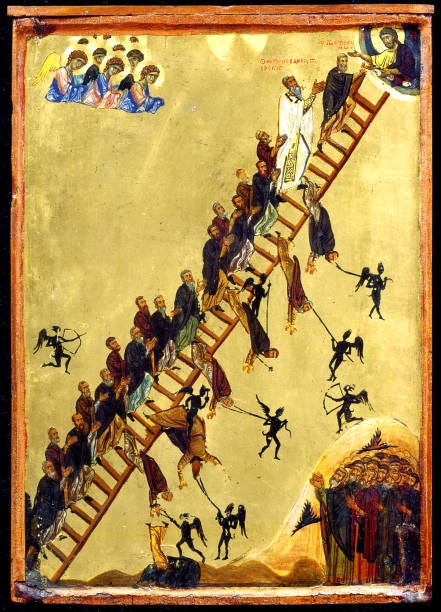
We called to a great destiny, to take our place in the celestial hierarchy. This is the same ladder of which Denys the Areopagite speaks when he says, “The aim of Hierarchy is the greatest possible assimilation to and union with God...by contemplating intently His most Divine Beauty.” This is important, because he’s teaching that the virtue of Love is the principle by which we attain greatness, not being the smartest guy in the room. He goes on to describe what the principle of ascendant love really means, describing it as a glowing beauty that cascades down from God who is pure Light, and it makes us glow with love and passes through us down into the orders below. Those who are highest in the hierarchy as those who give the most of themselves away, the most humble, the most self-emptying.
The more right you are, the more you ought to be lifting up those around you, the more responsibility you have to become a mirror of God’s love. This means becoming more Eucharistic, joining yourself to the sacrifice.
Less worrying. Less arguing. Less rage-baiting and trolling and getting worked up about the news. Less pride. Move into a deeper reality, a higher reality, a wider reality, one inscribed by the Cross, one that is buried with Christ and one that will ascend with him. Love defines reality.
Personally, I’ve made peace with how consistently wrong I am. It’s liberating. Life goes on. I repent and learn and change, admit my mistakes, and God still loves me. And somewhere up there at the top of the celestial ladder, Christ beckons. He calls. He never stops calling. His glory spills out down and through his creatures and spreads out over the whole face of the earth and his light embraces us, a love so persistent that nothing can stop it and it is here with us, poured out in the Eucharist, and Our Lord doesn’t really mind what we’ve been wrong about in the past, he is only concerned with our receptivity to his love right here and right now.
“One thing I ask of the Lord,” writes the Psalmist. Not to be right about everything, but “this I seek: to dwell in the house of the Lord all the days of my life.”
Yes, I think social media has something to do with this! Social media rewards the loudest voices, people who express themselves with the most confidence and criticize others.
This is a needed word because being “right” can become one of the most respectable disguises for being unhealed.
Truth matters. Doctrine matters. Conviction matters. But none of those things were given to make us impressive. They were given to make us truthful, humble, repentant, and available to love. The frightening thing is how easily righteousness becomes a possession instead of a participation in Christ.
The line about never being “right enough” lands deeply. The Christian life is not a climb toward moral superiority. It is a continual return to mercy until mercy begins to make us resemble the One who gave Himself for us.