
Alchemy on The Magic Mountain
The hermetic principles of redemption

Recently, because I’m a little bit daft, I re-read Thomas Mann’s The Magic Mountain. The novel is a sprawling 700 pages* about the distention of time. On the mountain, time unspools. It opens a door through which it cannot travel, but it flows through us and in us, and ultimately, if we use our time wisely, delivers us beyond itself somewhere in the higher regions bathed in alpine sun and infused with clear, healing air.
I say it’s daft to re-read The Magic Mountain because, really, once is enough for a lifetime. The writing forces the reader to experience that which it describes. It is long. It is carefully paced. It indulges in cyclic repetition. It makes the reader feel the weight of time, and the physical bulk of pages to be traversed stretches until it feels like flipping through them will take a lifetime. One review claims that Mann, in writing it, “used up all the words there are or ever will be.”
The way I see it, a book that bends the line of time into an orbit deserves a second reading. It’s only fair that I cycled back around to it.
In short, The Magic Mountain is a sign of contradiction opposing the rush of modernity. Modernity ushers in “dusk, rain, and mud, fire reddening a murky sky that bellows incessantly with dull thunder, the damp air rent by piercing, singsong whines and raging, onrushing, hellhound howls that end their arc in splintering, spraying, fiery crash filled with groans and screams, with brass blaring, about to burst, and drumbeats urging onward, faster, faster.” In our spiritually ill condition, mankind creates the conditions of disintegration. Willing slaves to our basest, most material level, we are helpless to halt the onslaught. It has us in its maw, the relentless anti-thing, the winding down of existence into satanic isolation. Materialism, the idolization of surfaces and appearances (“flatlanders”) as if they are the fullness of reality itself, this is our true sickness.
Mann rejects the flattening, dehumanizing effect of materialism, writing, “was not the very idea of a world of senses that existed in and of itself the most ridiculous of all possible self-contradictions?” It is effrontery. The senses must unveil the source in which they participate or they are nothing.
To climb up into the sight of such realities, mankind must undergo a spiritual alchemy, a “transubstantiation into something higher.” For this, we require a “magical pedagogy.” Mankind is sinful and fallen. We have made of time an enemy and subsequently succumb to death. We are too weak to save ourselves. What we need is “the application of external influence to force matter upward.” We are prima materia, unformed, waiting for the redemption of our potential that has been placed in us by God himself, waiting to feel the fluttering of wings cool our fevered skin.
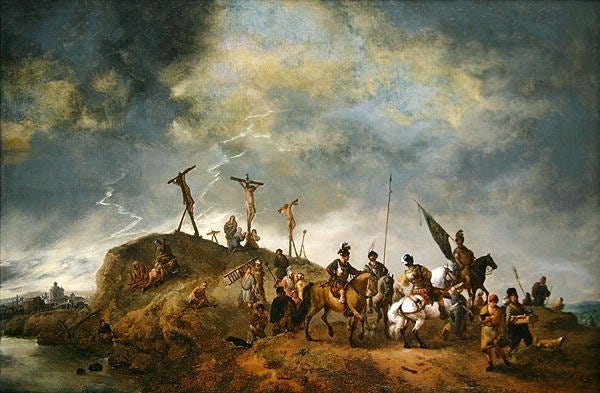
What is the upward force? It is precisely the disturbance at the surface. The divine wing hovering, penetrating, stirring us, rattling our cages. The Gate of Heaven is located in the suffering. Sometimes, healing feels like illness. This is why the grave is the poetic symbol of alchemy, “the epitome of all hermetism,” which functions as the transition of purification. I know this sounds high-flown, but we are speaking of nothing less than the Cross.
Hans Castorp, the hermetic adventurer of The Magic Mountain, “life’s problem child,” cannot help but think of the metaphor of canning jars; “hermetically sealed jars, with fruit and meat and all sorts of other things inside. There they stand, for months, for years, but when you need one and open it up, what’s inside is fresh and intact, neither years nor months have had any effect.” In other words, through mystical knowledge we are elevated through time into the timeless. Mann has it that the hermetic effect is to be, “withdrawn from time.”
This is the effect Hans experiences, drawn to the mountain and removed from time. Here, he is placed into the hermetic environs of the sanitarium where his mind and soul are elevated. He goes from a simple flatlander who only cares about a mediocre cigar in the afternoon to a participant in discussions on philosophy, medicine, botany, music, religion, and the nature of time itself. For seven years on the mountain, he is hidden away from time and exposed to alchemical pressure. He learns to suffer and he learns to love. “I have been forced upward into these regions where genius flourishes.” he says.
Hans knows that, “the substance to be transfigured must have at least a little something to it to begin with.” He declares that the “something” he possesses is an intimacy with sickness and death. It is his suffering that led him to love. It is in weakness that he is made strong.
I often wonder why Christ consented to die for me. I’m not so very important. There isn’t much to me. But he sees a little something in me worth saving, I suppose.
Hans says, “There are two ways to life: the one is the regular, direct, and good way. The other is bad, it leads through death, and that is the way of genius.” Do the saints not declare the same? That it is far better to lay our lives down in the sacrificial death of love and lay up treasure in the next world rather than clutch to our baubles and cling to the surfaces in this world? Isn’t the whole point of mystical faith to unite our hearts to the Cross?
We’ve been speaking of alchemy and mystical knowledge and hermeticism. I don’t want anyone to get the wrong idea. We aren’t talking about secret knowledge, the initiation of a select few, or some rare gift of contemplative ecstasy. We’re speaking about uniting our will to the will of God and how the only way to accomplish this is to meet Our Lord in his timeless sacrifice.
Redemption is a fearful thing, the act of abandoning everything for the sake of love, not quite knowing what value our meager gift has or if we can carry its generosity through all the way to the end. Inherent in conversion is the fear of being left behind in Gethsemane, unable to follow Christ into the grave. This would be the worst of fates, unable to die and thus unable to truly live.
We are not perfect, but Christ sees something in us worth saving. Something worth dying for. Even if we can love but little and with fragility, we can indeed love. And we can give ourselves to God. It’s a beautiful, humble gift. It’s all Our Lord asks. We earn nothing. We give everything, even if our gift is halting and imperfect. This is the economy of love, the very same gift-economy by which we receive everything. We give our small love and he returns to us his great love. We give time and he returns timelessness. We give our past and future and he returns to us the now. Father Thomas O’Meara comments on The Magic Mountain, “For inasmuch as it describes the hermetic education of a young hero into the timeless, it strives through its artistic means to dissolve, transcend and realize time through the attempt of a musical-ideal total world which it encompasses, in each moment it wants to give us a complete presence and yet to present the magical nunc stans.”
Just as Hans and Claudia agree in the novel, we are using our time to build an active alliance of friendship. Not against the world but for the world.
After spending years on the mountain, Hans drops his watch and it breaks. He doesn’t bother fixing it but, instead, measures the passing time by the ash on his cigar. He measures himself by that which has burned away. I cannot help but think of our post-lapsarian condition as ash. We are meant to burn and time is the spark.
The lost watch, “was his way of honoring the stroll by the shore, the abiding ever-and-always, the hermetic magic...the magic that had been his soul’s fundamental adventure.” To an outsider, the life of Hans Castorp seems insignificant, but his interior life has no boundaries. He has suffered on the mountain.
During a winter day, he is caught in a whiteout blizzard while skiing. Faced with the choice of life or death, he chooses to live. He has an epiphany and enters into the “poem of humankind.” There, right on the boundary of existence and non-existence, he is given the knowledge that man is, “More noble than death, too noble for it.” Yes, but there’s more. Man is also, “More noble than life, too noble for it.” What does this mean? It means that, “Love stands opposed to death,” and when we love we uncover a new, more full life within the life we already inhabit. A home within a home. A new identity. Love is eternity within us.
Abstract argumentation cannot hold a candle to becoming a personality. We become persons through the liturgy, which is to say, at the Cross and through suffering. Perhaps this is why, on Passion Sunday, Father O’Meara says his thoughts turn to The Magic Mountain.
Knowledge is granted through failure. Hans is a failure and thus a success. His hermetic education thrusts him back into ordinary life (as it should), but he returns the land below singing, full of music and beauty and memories of a lost love. He is a changed man.
To remain always captive to the flatland, where time is frantically thrown away in politics and business and errands, is the only ultimate failure. The only real failure is to refuse the risk of love. Physically, Hans fails to get healthy at the sanitarium (or he was never really any more sick than anyone else). This is the irony. His failure to heal on a projected timeline is what allows him to spiritually grow. Even if to an outsider he’s nothing but the captive of a hermetically sealed jar set apart from the productive use of time, he is nevertheless on an adventure of such scope that it defies verbal summary.
The first time I read the novel, I was impressed by the academic discourses and intellectual jousting. The second time, I skimmed those parts. They’re interesting enough, I suppose, but they aren’t the point. Hans initially needs to hear them, and we need them, but the abstractions alone aren’t fulfillment. The point isn’t to takes sides in a debate. The point is to plunge the knife into the heart of time and fight our way into the light. To get lost on mountaintops. To embody elevation. To live.
Magic, as practiced by pagans, is used for power, control, and manipulation. The irony of Christian “magic” is that the miracle happens through self-gift (think of C.S. Lewis, Aslan and the Deep Magic of Narnia). Christian alchemy is sacrifice with no expectation of golden reward or a quid pro quo. Christ is already the strong one and yet he makes himself weak. We do the same. We are here on this earth to explore our weakness.
Hans Castorp is eventually dropped back into the fight. This makes sense, after all, even being not of this world we are still in it. Still uncured, he must take up his civic responsibilities. In his case, to fight in the trenches of the First World War. He won’t go down easily, though, not without metaphorically carving his name into a tree like a lover. His hermetic story is a romance and, if he must sacrifice himself for the heights, well, now he’s ready.
“There must surely have been something to you,” writes Mann. The ordinary man who “plays king” may well be the very sign and symbol of royalty. He may indeed manage to place the purple robe on his shoulders and thorns on his brow. He may very well manage, finally, to join Our Lord and give himself fully to God.
The sacrifice of Hans Castorp is the, “intimation of a dream of love rising up out of death and this carnal body.” Will love someday rise up from us, too, like a flame devouring a lamb?
* I read the John E. Woods translation, which everyone seems to love
I see "hermetic" and think "occult"