
The Only Real Sadness
How the Holy Trinity overcomes our loneliness

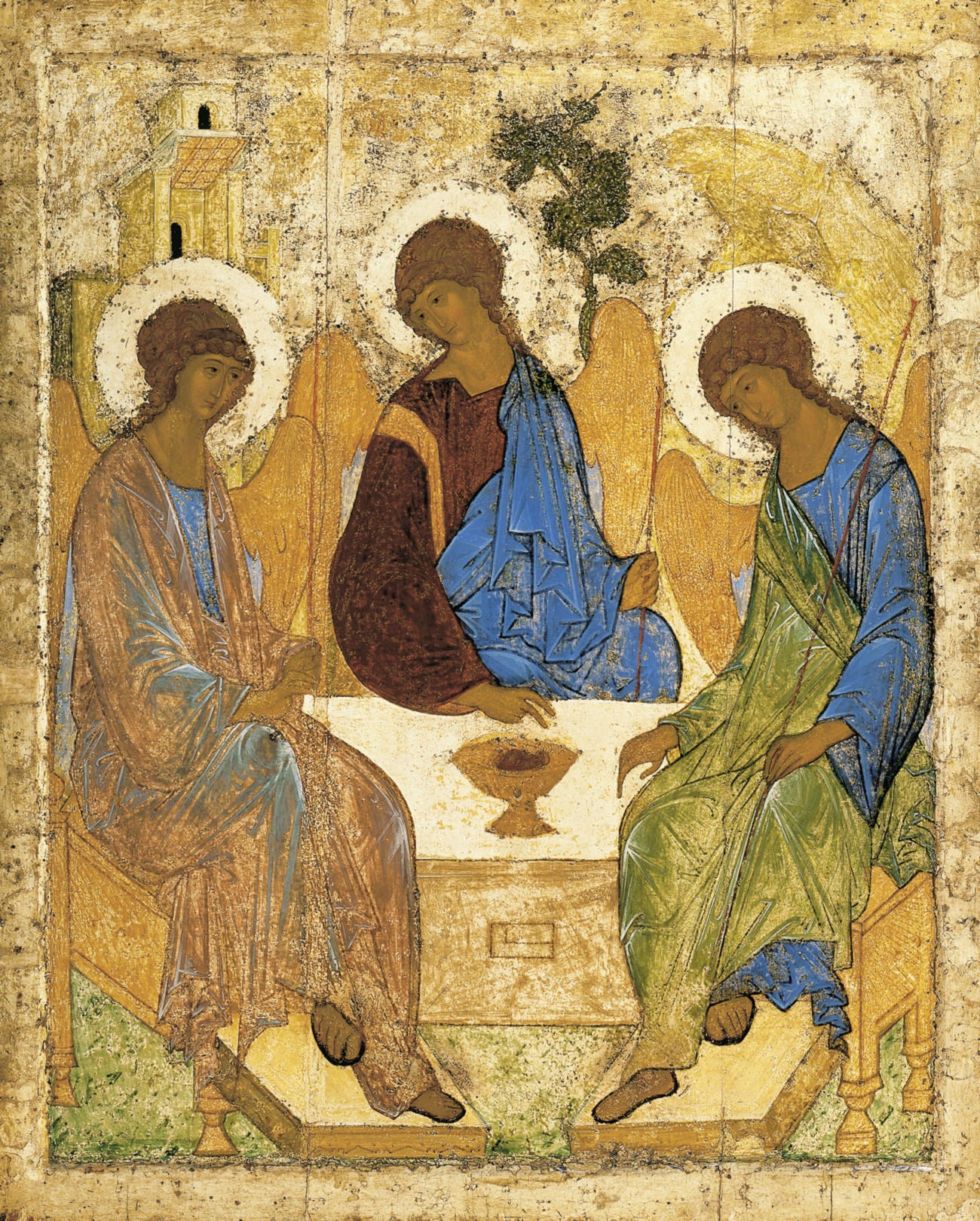
The French writer Leon Bloy says, “There is but one real sadness: not to be saints.” Gabriel Marcel says something similar: “There is but one sadness: to be alone.” A saint is a person who lives in intimate communion with God, remains in his presence, rests in his love.
Our Christian desire is to abide, even through afflictions, in the presence of God. As St. Paul says, “We even boast of our afflictions, knowing that affliction produces endurance, and endurance, proven character, and proven character, hope, and hope does not disappoint, because the love of God has been poured out into our hearts.” He’s saying that God’s love becomes internal to us. We participate in it such that we are living in constant communion with him and, because of this, even affliction is transformed into an opportunity for spiritual growth and increased love. This isn’t to say that it’s easy or that suffering should be dismissed with the wave of a hand because you can, “offer it up,” but it does mean that God can and will fold even the darkest moments of our lives into his goodness because he is always with us from birth to the grave, from Cross to resurrection.
Sin, on the other hand, is isolating. It isolates Adam and Eve not only from God, but also from each other, turns the physical world into an enemy, and even isolates them from their own selves. Socrates famously scoffed when he saw the writing on the wall at Delphi to Know thyself. This is an impossible task, he said. Walker Percy, the super-cynical 20th century Catholic novelist, puts it in his typical way when he writes, “The present age is demented. It is possessed by a sense of dislocation, a loss of personal identity, an alternating sentimentality and rage.”
It’s the perpetual strangeness of not being known, so many people putting versions of ourselves out there to know, our vacation pictures, little memes, filters, deep thoughts. We’re desperate to feel known.
This sense of dislocation is something I’ve struggled with, and that image of seesawing between sentimentality and rage perfectly describes the state of my soul when I was in my late-teenage and college years. At that time, I was clinically depressed, insomniac, and going through what, in retrospect, I recognize as a tidal wave of spiritual trauma. I don’t want to rehearse too much of the gory detail, but I was at Oral Roberts University studying to become a Pentecostal pastor and all around me the leaders who were supposed to be shepherding those churches, the men and women I admired and wanted to be like, were constantly being caught up in scams and scandal. I felt deeply betrayed. I was attending theology classes and at the same time refusing to attend church. I certainly extended my rage to God himself and I can personally tell you how righteous anger, if held onto for too long will poison you and become a deadly sin. It threw me into grave mental and spiritual difficulty. We must be very, very careful how we react to religious leaders who let us down (and they will) and we must be very, very careful how we react to affliction and disappointment in the course of our lives. Over time, bitterness and anger, if we allow them to take root, will destroy our relationship with God. I can’t warn you about that too clearly. Avoid anger and bitterness. They isolate us and put us a very dangerous spiritual position.
Loneliness, that sense of anxiety, the social nervousness caused by social media, the disconnection we have from each other, the way people have become so quick to break ties with a church that even slightly lets them down, or abandon a friend for similar reason, or even family. This tendency towards loneliness, it isn’t normal. God didn’t create us to feel this way.
It reminds me of Dante, who after having spent a long, lonely night alone jumps up when he sees Virgil approaching in the morning, saying, “Have pity on me, I imploring cried/ whether thou be of shades or real men.” In other words, he was so lonely he didn’t even care if a ghost was coming to keep him company.
Returning to what St. Paul says – use affliction for the good. It’s the warning sign that changes need to be made. If nothing else, it’s an indicator that we are made for transcendent love, for communion, and when we lack that we become profoundly unhappy. Affliction should throw us more firmly into our families, more firmly into the communion of saints.
For me, melancholic anxiety pushed and pushed me until I knew I had to find a solution. Eventually I was able to reconnect with God via the Episcopal Church and finally on into the Catholic Church. I knew that I couldn’t spiritually struggle by myself any more. I needed the communion of saints. I needed the Body of Christ. Essentially, I needed you. We need each other.
Our Lord’s whole work of redemption intends to mend the rupture between individuals by re-establishing communion between us and God and thus reestablishing communion between human beings and also internally within ourselves. To this end, Our Lord teaches, “All that the Father has is mine.” It’s a fullness of love, he shares all of himself with us, and what God is, is a Trinitarian communion by which the three persons of the Trinity fully participate with each other. In this manner, glimpse something of the mystery of three persons who are a unified, single God. It’s perfect love that draws incredibly sharp distinctions – the Father is not the Son and the Son is not the Father – and at the same time fully unites – The Father is God, the Son is God, and the Holy Spirit is God. As Pope Pius XII says, “God with his love neither destroys nor changes nature, but perfects it.” His love makes you more uniquely yourself while at the same time bringing you into a full participation in the life of the Body of Christ.
Our happiness lies in achieving sainthood, and sainthood consists in communion, in being fully integrated into the Body of Christ. It’s all shared with us through Christ himself, who is the living image of the Trinitarian God.
There is one real happiness, to be drawn into the endless love of the communion that God shares with us from within his very heart.
Oh Fr. Reiner, the first paragraph in itself was a whole homily, but what follows is such truth! “The Hospitality of Abraham “ is absolutely my favorite icon. So grateful to have Msgr. Morris and you as shepherds of our flock.
Good post. I'm struggling with how to relate with family who reject Tradition, or aren't even practicing the faith St all. Family reunion coming soon and I want to boycott; very conflicted.